

Salary vs. Dividends for Startup Founders
Many founders ask: Is it better to pay yourself a salary or dividends?
Usually, the answer is salary.
There are some specific situations where dividends are better, but most early-stage startup founders benefit more from paying themselves a salary.
Why Salary is Usually Best
-
Grants and SR&ED Credits
-
Salary expenses count for SR&ED tax credits which is Canada’s main tax credit for R&D.
-
There are many grants available to startups but they usually require you pay salary.
-
These credits and grants can put real cash back into your business, especially SR&ED. The government is paying you to pay yourself a salary.
-
-
RRSP Contribution Room
-
RRSP (Registered Retirement Savings Plan) is a tax-sheltered account that lets you invest money and defer paying taxes on it until you withdraw from the account (generally in retirement). It is great tool for your personal finances.
-
You only earn RRSP contribution room when you pay yourself a salary.
-
If you pay yourself only with dividends, you won’t build RRSP room. You will lose out on a valuable tool to save for your retirement.
-
-
CPP Contributions Can Help You Later
-
CPP (Canada Pension Plan) is a government program that gives you a monthly pension after you reach a certain age (60 to 70).
-
With salary, you contribute to CPP. With dividends, you don’t.
-
Many people view CPP as a tax and pay be more inclined to pay dividends instead. However, it is really forced retirement savings. It’s money you get back later.
-
-
Taxes Are Similar Either Way
-
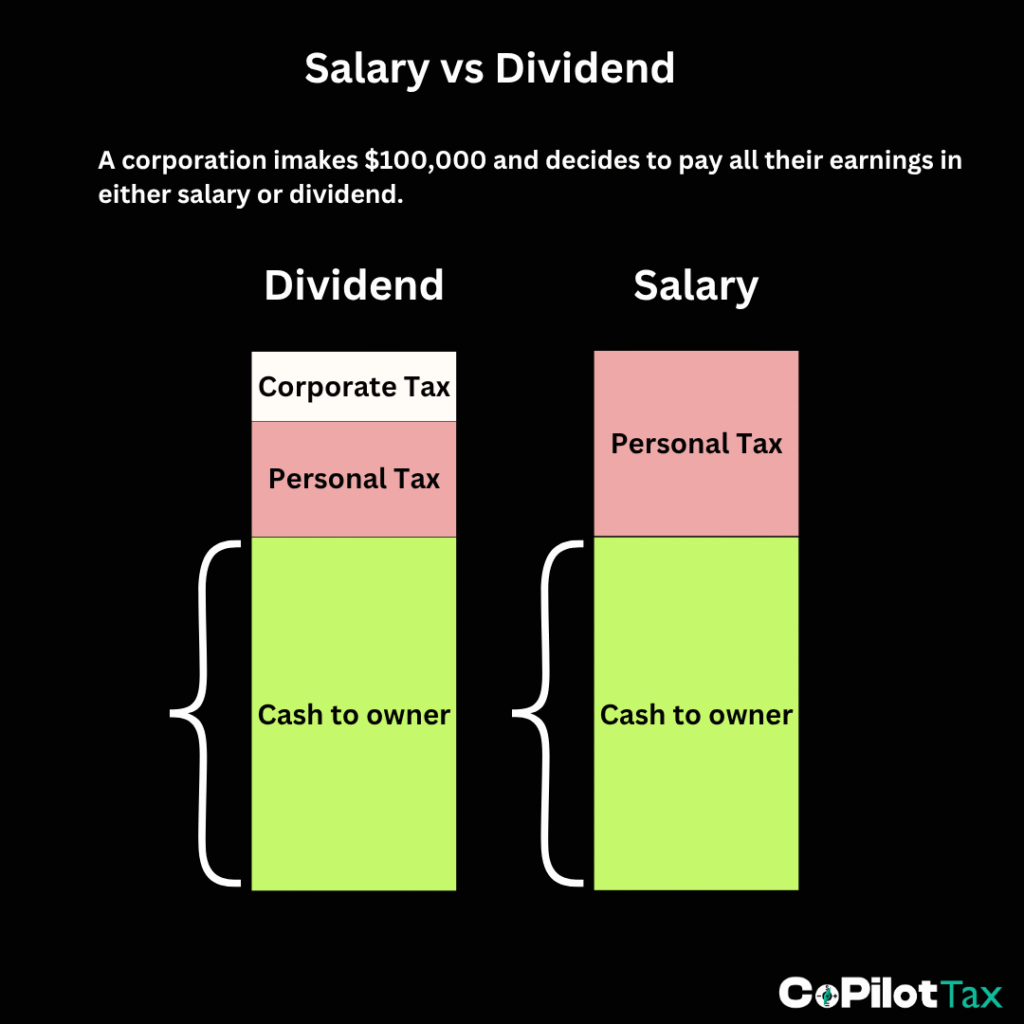
Whether you pay yourself by salary or dividends, the total tax bill is often similar (except for CPP which is not a tax).
-
This is why the decision is more about long-term strategy than just saving money this year.
-
The Extra Advantage of SR&ED Credits
If your startup does R&D work, a portion of your salary may qualify for tax credits.
For example, if you pay yourself $100,000 and your full salary qualifies, the company could get $50,000 back in tax credits.
That makes the net cost of a salary much lower than a dividend.

When Dividends Might Make Sense
Dividends can still be a good option in these scenarios:
-
If cash is extremely tight
-
Dividends avoid CPP contributions, keeping a little more cash in your pocket. This is generally not the best for the long-term but it may be necessary for years where there is a severe cash crunch.
-
-
If you have raised a funding round and are investing excess cash
-
Investment income earned by your corporation is taxed at a high rate, but your corporation can get back some of that tax (refundable tax) when it pays dividends.
-
In this case, dividends can help recover some of that refundable tax.
-
But be careful: most investor agreements restrict dividends unless paid evenly across all shareholders.
-
A Simple Decision Flow
-
Early Stage: Salary is almost always better.
-
Cash-Strapped: Dividends can help avoid CPP if every dollar counts.
-
Post-Funding or Cash-flowing: If you have a lot of excess cash earning investment income, consider dividends (if allowed).
In all other situations, salary is the better long-term choice.
Plan Your Salary Dividends Strategy
Choosing between salary and dividends is not just about taxes. It impacts cash flow, grants, retirement savings, and your company’s growth.
Use our salary vs dividends calculator to see the difference for your own numbers.
At CoPilot Tax, we help startup founders plan a smart salary dividends strategy that balances cash flow with long-term wealth.
Contact us to design your plan today.